Togonon Gallery Circa 2010
For a number of years this was the Togonon Gallery's website.
Content is from the site's 2010 archived pages providing just a glimpse of what this site offered its visitors.
Yelpers report this location has closed.
Togonon Gallery - Closed Jan 2012
Togonon Gallery
77 Geary St # 200
San Francisco, CA 94108

STORY/MISSION
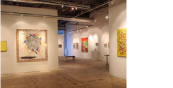
Togonon Gallery originally opened as the “Washington Square Gallery” in 1994 in the historic North Beach neighborhood of San Francisco. The gallery started out in a 1,000 square-foot space primarily showcasing local artists. In January, 2006, the gallery expanded and relocated to a 3,000 sq. ft. space at 77 Geary, near Union Square in downtown San Francisco. The gallery presents 8-10 shows annually. National and international shows are presented 1-2 times per year. Togonon Gallery became a member of the San Francisco Art Dealers Association in 2003.

Togonon Gallery works with emerging and established West Coast and International artists in all media. Many of our established artists were active in the major art movements of the twentieth century, including Abstract Expressionism, Minimalism and the Bay Area Figurative and Realist traditions. Their work as practitioners and teachers has paved the way for contemporary painters.
Our emerging and mid-career artists investigate a myriad of styles and themes inspired by contemporary American and global life. Individually, each of our artists explores subject matter of a universal resonance, filtered through the particular lens of the West Coast, and their personal experiences. Our artists’ work explores the politics of living in the 21st century society, the point of intersection between the natural and industrialized worlds, experimentation with the process of creation via a combination of mediums.
We envision Togonon Gallery as a dynamic space for the possibility of a lively dialogue about contemporary life. Our passion is to present exhibitions that will keep the energy alive for the arts.
Focusing on your distinctive needs –
For 15 years, Togonon Gallery has assisted private, corporate, and museum collections select art to meet their unique needs . Director Julina Togonon and Associate Director Rafael Musni cordially invite you to visit Togonon’s spacious loft-style gallery just off Union Square at Geary St, near Grant. In an engaging and inspiring atmosphere, this is where you discover new talent from top art schools in the country as well as noted established Bay Area, western and international artists, some of whom represent cultures new to art collectors.
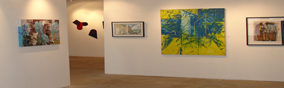
Togonon Gallery, a member of the San Francisco Art Dealers Association, participates in First Thursday gallery openings.
ARTISTS
Painting/Mixed Media
Jane Catlin*
Constance Chang
Lori Del Mar
Ariel Erestingcol*
Servando Garcia*
Allen Guilmette
Connie Harris
Daniel Kim
James Leong*
Brigid McCabe
Ben Needham
Johanna Poethig*
Sam Provenzano (estate)*
Hilda Robinson*
Charles Schucker*
Leo Valledor (estate)*
Fan Lee Warren*
Gary Woo
Kelvin Ming Young
Sculpture
Steve Baibak*
Xuchi Naungayan Eggleton
Peter Forakis*
Connie Harris
Viva Paredes*
Photography
Richard Bluecloud Castaneda
Grant Davidson
Dean Dempsey
Jack Fulton*
Marion Gray
Hiroyo Kaneko*
Malcolm Lubliner*
Klea McKenna
Darcy Padilla
Jackson Patterson*
Jessica Skloven
Lucia Zegada
JANE CATLIN
Jane Caitlin synthesizes painting, drawing, and printmaking. Constructed on Mylar, her art portrays biological forms altered by spiraling changes brought on by rapid population growth and rampant industrialization. The imagery refers to the adaptations organisms go through in order to survive change–environmental and otherwise. Jane holds an MFA from the Rhode Island School of Design, is the recipient of several awards and grants, including the Pollock-Krasner Foundation Grant. Her work is in the collection of the Harrison Eccles Museum of Art in Utah. Currently she lives in Logan, Utah where she is Associate Professor of Art at Utah State University.
Constance Chang
Constance Chang (Chang Shangpu,1918- ), is “one of very few women artists of her generation to have gained a significant reputation as a painter. Her art and life provide a valuable narrative for modern Chinese paintings as it developed outside the mainland in the second half of the 20th century.” (Foreword by former Asian Art Museum Director, Emily Sano in Chang’s 2004 Exhibition catalog at the Asian Art Museum, San Francisco).
Chang was born into a scholar-gentry Nanking family yet had a career acting in movies in Shanghai in the 1930s and 1940s. Moving to Hong Kong in 1948, she took up art, studying classical painting with the traditionalist Huang Pan-jo, and the modernist Lu Shouk'un. She evolved a style of bold, calligraphic strokes (sometimes with unorthodox painting implements) in ink enlivened with small touches of color that allowed her to improvise freely within the Chinese tradition. She moved to San Francisco in 1974.
Chang's work began with experimentation and her responding to the modern art movements which were taking place. The western world began to influence her art with the rise of Picasso's collage work. Being inspired by the idea of "eight broken"(bapo), she began to learn new techniques for making her paintings. In her painting entitled "Chrysanthemum", Chang used cotton balls to create the texture of foliage and the rim of a dish in order to outline petals. This exploration led Chang to become less concerned with the design of her painting and more excited about spontaneity.
In Asia, Chang had solo exhibitions at the Shanghai Museum, Beijing National Gallery, National Gallery, Taipei Hongkong Museum of Art and and art venues in Hongkong and Tokyu Gallery. In Europe, she has exhibited in London, Paris, Copenhagen, and Frankfurt. In the U.S. she had solo exhibitions at the University Art Museum at Berkeley and at the Asian Art Museum. She lives in San Francisco.
Reference: Li, He & Li, Chu-tsing "The Elegant Lotus: The Art and Life of Chang Shangpu (Constance Chang)", 2004, Asian Art Museum-Chong Lee Center of Asian Art.
LORI DEL MAR
Lori del Mar’s paintings represent an inquiry into aspects of time and perception. Her subject, in many ways, is the viewer and the viewer’s attentive participation in looking and seeing.
del Mar speaks of her work as “essentially about being in time… of slowing to explore the sensory threshold of awareness and perception”. In viewing her work, we are uncertain at times as to what we are seeing, and, as such, are invited to relinquish any immediate visual expectation. The delicate modulations of color, light and shadow seem to shift, deepen and thus reward our sustained gaze. With their bevel-edged frames and lustrous surfaces, del Mar’s paintings appear to intangibly float on the wall, further punctuating their performance in time and space.
Lori del Mar’s work has been exhibited throughout California and included in exhibitions at the Berkeley Art Center, The Crocker Art Museum, the Monterey Art Museum, Sonoma Museum of Visual Art, Arts Benicia, and at the Sebastopol Center for the Arts. In 2005/2006, Delmar received the Murphy Cadogan Fine Arts Fellowship, and was a Graduate Fellowship recipient from the San Francisco Art Institute for 2004-2007.
BEN NEEDHAM
Emerging artist, Ben Needham’s most recent work reveals how a “landscape” serves as a metaphor for “memory.” Needham describes this imagery, “Layers of unearthed/geological cross-sections allude to the concepts of time and accumulation (natural processes). The angular cutaway of the landplates, suggests our possessive nature through the privatization of land, but also represents private realms of property, memory, and space."
In presenting details without context Ben Needham inspires the viewer’s associations. Presenting elements of an untold story- a factory with a puff of smoke, a quaint house, laundry swaying on a line- makes the viewer question the narrative that surrounds these details. However, it is difficult to imagine a story from these details because these isolated landmasses cannot sustain life. Encouraging the viewer to imagine but at the same time limiting his resources, the artist reveals man’s unsatisfied desire to keep his memory intact. But just as it seems strange to artificially divide and manipulate nature- as evident by the cut-up swath of land folded to bring two homes side by side- so, memory, which is subjective and ever-transforming in one’s mind, is almost impossible to keep intact or “reclaim."
Needham’s landmasses, represented as geological diagrams, are symbolic of a search for understanding. Through multiple studies of earth samples, Needham’s works recall the environmental engineer’s examination of outcrops, used to predict geological patterns deep within the earth. Using landscape as a metaphor for memory, each work portrays a mental landscape. Surrounded by fields of moving blue paint, devoid of humanity, the image feels like a dream in which symbols are clues to the dreamer’s subconscious mind. Thus, by using landscape as a metaphor for memory, Needham discusses man’s search for an understanding of his own mind.
His work has been featured in various galleries, including the Gallery Op-Nord in Stuttgart, Germany and the Ichys Gallery in Tokyo, Japan; in addition to a number of San Francisco galleries. Needham received a B.S. in Fine Arts from Skidmore College and an MFA in Painting from the San Francisco Art Institute. He lives and works in New York.
HILDA ROBINSON
Robinson uses oil pastels to create evocative paintings that depict everyday lives of African Americans - from playground, to home, to school to leisure and church. Though educated in art, her work appears folksy and self-taught. This paradox plays out in colorful scenes centered on people and their interactions. Robinson’s painting practice is informed by the rich history of self-taught African American painters, humor, and storytelling. Art critics have described Robinson’s art as “glowingly human”. “The beauty and significance of the figures are not there because the figures are exotic or unusual, but precisely because they are mundane. The subject matter is ostensibly about Black culture, but depicted in such an affirming way that there is a universal quality.”
Hilda Robinson lives and paints in Oakland, California. Her gift as a painter was discovered at a tender age of three, when her father bought her first paint box. Her talent was nurtured until she enrolled at Tyler School of Fine Arts at Temple University. She completed her BA and MA studies in art at UC Berkeley. Robinson has received the prestigious awards Jan Hart-Schuyers Merit Award through the "Art of Living Black" exhibitions at Richmond Art Center (2001) and the Atlanta Life Insurance Purchase Award (1988).
FAN LEE WARREN
Warren’s newest mixed media work provides a moving look into the African-American experience. Her lifelong fascination with visual references to African-American history, slave life, and colonization are evident within these recent series. She enhances the historical allusions by administering a unique procedure in which she physically “ages” the work surface using earth, fire, and herbs before applying an itermix of paints, pastels, and charcoal.
Born in Birmingham, Alabama, Warren earned her MFA from the School of the Art Institute in 1985 and a BFA from Illinois State University in 1982. She has been exhibiting her sculptures, drawings/paintings, and installations for 20 years. According to art historian Constance Cortez, Warren’s pictorial fragmentation can be linked to Robert Rauschenberg’s work and her use of symbols relates to traditions of representation established by Betye Saar. She has received various grants and awards including an Oakland Creative Artist Fellowship Grant; National Endowment for the Arts (NEA), the California Arts Council (Artist in Residence Grant); and Astraea Foundation Visual Artist Award. The artist continues to teach painting and art history at Laney College in Oakland, California.
KELVIN MING YOUNG
Kelvin Ming Young’s paintings are created through a process of “momentary detachment” and free-association with abstract patterns. Young’s subconsciously-envisioned mark-making reflects his personal internal world, visually expressing issues of social and cultural identity. Young draws inspiration from daily life, nature, science, food, childhood memories, Chinese culture and Buddhist art. His paintings emerge as conceptual webs of organic shapes, symbols and motifs. Kelvin Ming Young was born in Taiwan and immigrated to the United States at the age of 12. He received a BA from U.C. Berkeley and an MFA from the San Francisco Art Institute.
XUCHI NAUNGAYAN EGGLETON
Xuchi Naungayan Eggleton refers to her work as “baroque minimalist,” a phrase which is both precise and insufficient; while it captures the physical and conceptual complexity of Xuchi’s sculptures, the phrase misses the all-important influence of nature. Eggleton describes her work as looking like “it’s pulled out of geological time,” a “manmade geological phenomena.” Paradoxically, this very purity - the purity of time and the forces of nature – is an methodically crafted illusion. Though they mimic the forms and patterns of rock, eroded by wind and water, or of shards of ice and stone, Eggleton’s sculptures are in truth meticulously hand-crafted. While their form and composition suggest stability and weight, they are surprisingly light, delicate, and soft. They suggest centuries of harsh weather and a context of wild exposure, but we know they are the youthful output of a contemporary studio, not yet in existent during those long centuries, but present in the seed of inspiration passed.
STEVE BAIBAK
For Steve Baibak, making art is an interactive story between the things he grabs and the things that grab him. Drawn to the fresh, new, vivid, and strange, artist and object alike are an undefined mystery. For Baibak, that's pure West Coast style. While Baibak's joie de vivre is as playful as his artwork, his effect is, nevertheless, downright reflective. Skimming the surfaces of nature for texture, color, and shape, Baibak coaxes materials of life to present themselves anew. Mosses and lichens influence his perspective just as "the place where the smooth sky meets a rough dry grassy hillside" inspires form. But the joy isn't all Baibak's. To see Baibak's sculptures is an exercise in fancy. His stuffed works defy predictability by looking deceptively light when heavy or seeming heavy when light. Some even seem to grow and move right bfore your eyes -- recreating themselves at every turn of the head. To say the least, Baibak's art is West Coast art. It makes real the mythology of the wild, unsettled territory primed for exploration. It delights in the obscure and encourages the absurd. It's 21st century and time immemorial. It's simply Steve Baibak.
JACK FULTON
hotography was Jack Fulton’s method of answering the questions that had been brewing inside of him since he was a child. Art is “to mate experience with consciousness.” In other words, one’s perception of the world is influenced by the things one experiences, reads, and observes, and art, specifically photography is the product. Through photography, Fulton could find a “soupcon of truth”; analogizing his process to alchemy, Fulton learned “to fuse difference into meaning,” realizing that his work and his life were an “amalgam.” Fulton describes his use of mathematics, free solo in jazz, and stream of consciousness in writing as “tools” to “create a fictional portrayal of a personal reality.”
Jack Fulton is recognized as an influential West Coast photographer. He has been teaching at the San Francisco Art Institute since 1969. Fulton is a three-time recipient of the National Endowment for the Arts Grant. He has been exhibited world-wide with notable artists such as Joan Brown, Lee Friedlander, Bruce Nauman, John Divola, and Robert Heinecken. He is published in numerous fine art photography surveys including SF MOMA’s Photography in California, 1945-1980, and the Oakland Museum’s Picturing California: A Century of Photographic Genius. His photographs can be found in the collections of numerous institutions including SF MOMA, Biblioteque National, Paris, Musee de Art Modern, Paris, Oakland Museum, LA County Museum, Chicago Art Institute, San Jose Museum of Art, University of Arizona, the DiRosa Foundation, UNOCAL and Seagrams.
Jack Fulton’s Cibachrome dye-bleached photograph series entitled “A Vainglorious Decade” illustrate his belief that one’s experiences and observations affect one’s perception of the world. Fulton explains that the photographs that he took in his travels through the American West “echo” the “spirit” of the 1970s as “visual similes.” Momentous sociopolitical events of the 60s and 70s- such as the assassinations of Martin Luther King Jr., JFK, and Malcolm X, the failures of the Vietnam War, the Kent State killings, the first test tube baby, the release of the Apple computer, and the election of the first black congress person, to name just a few- accounted for Fulton’s “mentally constructed photographic eye.” In these photographs Fulton addressed his broad interests, which were “somewhat political” including racialism, feminism, Buddhism, and the rise of environmentalism. His photography was also influenced by the experiences he had during his journey through the West, and the embrace of color and other technological improvements in photography in the 70’s.
HIROYO KANEKO
Hiroyo Kaneko produces large-scale pictures of people within the weft of their daily lives, as well as 35mm photographs portraying fragmented landscapes. Her photography draws attention to how the different ingredients of the material world – light, shadow, architecture, nature, human life – work together to form a visual whole. Kaneko’s integrative works conceptually and literally reveal the visual richness and complexity of our society’s everyday life.
Hiroyo Kaneko was born in Aomori, Japan. She received her B.A. in French Literature from the Meiji Gakuin University in Tokyo, and went on to earn an M.F.A. in Photography from the San Francisco Art Institute. She lives and works in San Francisco
MALCOLM LUBLINER
Malcolm Lubliner’s current body of work is a continuation of a series he started in the early 1980’s. The images were originally conceived as small theater pieces conceptually related more to the art of assemblage than to the traditional still life. They were, in part, designed to make use of a now discontinued Kodak material called Translite, which enabled the photographs to appear surreal, recalling Man Ray’s 1920’s Rayograms. One of the visual experiments in this work references three-dimensional allusion in two-dimensional spaces where things like gravity, time and motion can be manipulated without the usual constraints of physical reality.
About an earlier series titled The Anxious Landscape art historian, Robert Mattison wrote “Lubliner’s photography captures a late-modern sensibility: his photographs of suburban landscapes show how humankind everywhere impinges on nature; the imposition of sign systems and barriers upon the natural world is one of the marks of our age. Yet the humans who made these objects seldom appear; he does not treat his subjects with nostalgia but self-aware skepticism; and finds pathos in the ordinary.”
Lubliner’s most profiled work, his archive of working portraits of renowned American artists, emerged from his decade at Gemini G.E.L. the Los Angeles art publisher beginning in 1968 and his commission as the principal photographer for The Los Angeles Museum of Art’s historic Art and Technology Program between 1969 and 1971. During those years Lubliner worked with some of the most celebrated contemporary artists, such as Robert Rauschenberg, Claes Oldenburg, Jasper Johns, Roy Lichtenstein, Frank Stella and Richard Serra.
Malcolm Lubliner received his MFA at the Otis Art Institute, Los Angeles, California in 1962. Since then, his work has been exhibited nationwide and internationally in Paris, London, Berlin and Japan. His work is in the collection of the San Francisco Museum of Modern Art, Los Angeles County Museum of Art, Oakland Museum, UC Berkeley University Bancroft Library, the California Museum of Photographic Arts, San Diego, the Crocker Museum, The National Portrait Gallery and the David Packard Collection.
JACKSON KYLE PATTERSON
Jackson Patterson’s photography is both traditional and contemporary, reflecting the shaded area between conventional and modern practices. His works have evolved from the emotional, intuitive response of looking-- to the intellectual aspect of creating images. Existing in the space between these processes is where Jackson often finds the most poetic images about nature, family and what it is to be living in today’s world.
Jackson Patterson was born and raised in Arizona where he developed an appreciation for both the beauty and austerity of the desert and the lush diversity of nature. He is a seasoned traveler whose artistic and personal curiosities have taken him throughout the U.S., Mexico, South America and Europe but always, he returns to the American West, and finds the expansive and diverse scenery to be home. At an early age, the works of Edward Curtis, Timothy O’Sullivan, Edward Weston, Carleton Watkins and other photographers depicting the West inspired Jackson. Soon, his artistic influence and appreciation came to value contemporary works and the dualities often present in modern life.
Jackson’s latest work merges his photos of landscapes with his family albums, attempting to collocate the medium of photography, 21st century digital practices, with the personal. The results that come into focus are new fantastical stories. Each blended piece possesses its own original story while the viewer takes away another version that is his or her own.
Jackson received an MFA from the San Francisco Art Institute in 2009. He has been exhibiting his photographs in Pennsylvania, Oregon, California and Arizona since 2000 at the Morris Graves Museum of Art, the Pendleton Art Center, and the Diego Rivera Gallery. His work is in various private collections and in the Paul Sack Collection at the SFMOMA. Jackson currently resides and works in San Francisco.

BLOG POSTS FROM 2010
Kenneth Baker reviews Klea McKenna in San Francisco Chronicle
October 18th, 2010
Excerpt from the San Francisco Chronicle, Saturday, October 16, 2010
-By Kenneth Baker
Cameraless “pictures”: “Peripheral Vision” at Togonon introduces three newcomers who use photo technology and chemistry in unusual ways: Klea McKenna, Rebecca Nadjowski and Jessica Skloven.
Klea McKenna Paper Airplanes photogram installation
Each offers work of visual and conceptual interest, but one must not be missed: McKenna’s “Paper Airplanes” (2010). It presents a grid array of 40 sheets of creased photographic paper, each shadowed differently by its exposure to daylight.
To produce it, McKenna made a paper airplane of each sheet. She exposed them to hours of daylight at the Northern California site of one of the World War II anti-aircraft lookout sites.
The “Paper Airplanes” have a faceted look that recalls early Cubism and its mimicry by the Italian Futurists, who gloried in the prospects of mechanized violence. Some of the darker ones have the capelike, creepy geometry of the Stealth bomber and its kin.
With “Paper Airplanes” – topical, yet abstract, formally satisfying, yet conceptually rich – McKenna has set a high standard for her own future work.
+++
Photography review as seen on ArtSlant
October 15th, 2010
Klea McKenna Paper Airplanes photogram installation
The edges of Contemporary Photography are lined with a select group of individuals deeply concerned with the medium’s rapidly disappearing analogue processes and materials. Togonon Gallery’s newest exhibition, Peripheral Vision, features the work of three such artists: Klea McKenna, Rebecca Najdowski, and Jessica Skloven.
The three recent California College of the Arts MFA graduates each utilize and manipulate their craft to produce visually stunning and conceptually gripping photographic images. The exhibition’s subtitle “photographs without pictures” succinctly defines the presentation perfectly. Each of the artists are departing from traditional image making technique while paying homage to Photography’s roots in the material and chemical.
Upon entering the gallery the viewer is confronted with a series of striking images by Jessica Skloven reminiscent of abstract color field paintings. Skloven’s subtle work hangs precariously in the balance between reality and a state of suspended animation. The images, taken from her newest body of work Domestic Seas, use landscape as a point of departure and ascend far beyond the earthly realm. The photographs have no distinct horizon line nor do they contain any distinguishable sense of space or point of view. They inhabit a plane of undulating emotion culled from the depths of the viewer’s own experience. Saturated bursts of color float between aqueous shapes. Skloven explains that the work was actually created in the confines of cramped interiors by pointing her camera on mirrors, windows, and walls during her recent travels in Southeast Asia.
In a time of digital trickery and perfection, Rebecca Najdowski opts for intricate photogram and “camera-less” techniques. Her images produce celestial and mystical visions through the use of commonplace plastics and distorted light sources. Her works might be considered the least abstract of the show, as several feature the discernable shapes of crystals and tribal masks. These references are balanced with bright, sinuous color and frantic light forms on paper. The colors she attains are reminiscent of deep-space nebulas or Amazonian body paint. Najdowski’s work rests in the realm of the phenomenal. She seems to be fixated on the subliminal nature of ritual practice and the magical occult, giving her work a transcendental dominion over the photographic plane.
The far end of the gallery features a sculptural grid of unique Chromogenic prints by Klea McKenna. As noted by a statement tacked to the wall next to the work, McKenna has folded her sheets of paper into airplanes and exposed them over a period of ten hours at a World War II memorial in Tennessee Cove, California. While the simple statement seems unnecessary, the resulting prints are anything but. The creases in the paper create luscious hues of reds and oranges in arresting geometric patterns across the wall. Rich blacks are compounded with diamonds of blood red and wisps of ochre. The attention to paper is mirrored in the other works presented by McKenna. Three gelatin silver photograms bring the textured surface of the paper to life. Here, geometric patterns are broken down into more organic forms connected by frangible threads on the verge of breaking. These works are by far the most delicate of the show, with their subtle differences drawing the attention of the viewer from one to the next.
+++
What’s on the Wall
October 14th, 2010
Process and Photography
by Nicholas Pollack
The importance of analog processes and the photogram underlies the value of photography. Photography traffics in time: the measurement of the sun’s light and the constructs of the mind. The three artists featured in the exhibition “Peripheral Vision: Photographs Without Pictures” at Togonon Gallery are contributing to the canon of photography by making a physical contribution to the medium that is not only suggestive of craft-based and alternative processes, but this offering is comprised of the light and raw materials that permit the creation of a photographic image. The action of light on a sensitized surface grounds these works in a tradition extending from early primitive mark making to 20th century photography.
Jessica Skloven’s self-reflexive images from her series Domestic Seas are experiments in space and color. The prints are representations of an interiority-exteriority dialectic occurring within the limitations of the medium. Light refracting off of close range walls and mirrors in front of the lens permits access to an altered landscape, made real by the camera.
Rebecca Najdowski and Klea McKenna’s unique photogram works reference the materiality of photography. These works speak to historical images such as Man Ray’s photograms, and they point to the potential for non-traditional image making by contemporary artists. The emotionality of non-realist imagery is evident in Najdowski’s metamorphic materials – scraps of daily life transformed into questions about the function of photography.
McKenna’s Paper Airplanes exude the spirit of the medium with the repressed kinetic energy of toys. The paper airplane is a handcrafted object charged with the cultural history of WWII anti-aircraft activity off of the Sonoma and Marin coasts, yet its existence requires only the paper itself, the wind, and the sun. The harmonious dance of a fragile paper plane dancing in the wind to the pulsing chemical changes of sunlight reacting with emulsion: the marks of Photography, History, and Time.
-Nicholas Pollack
+++
October 9th, 2010
Servando Garcia returns with warm and bright colors deftly placed and yet appearing to be natural occurences in his interior landscapes. His representational work, verging on visual obscurity, captures the viewer, entreating the passerby to make sense of the what is causing the image. At a time when art and design is overwhelmed with graphic images and cartoon-like lines and vectors, Garcia’s work remains engaging and aesthetically pleasing.
His latest work offers viewers quirky, idiosyncratic spaces, ranging from the humorous to the uncanny. Garcia’s favorite subject matter is daily life, where as observed by art critic Kenneth Baker, the artist “takes on the disconnection between painting and ordinary life by dissolving images in streaming brushwork.” Garcia’s other favorite subject noted by art critic DeWitt Cheng, is “the act of painting”, where Garcia’s apartment interiors are not constrained by the rigors of representation…and more free to let paint be paint.” Garcia completed his BFA from the San Francisco Art Institute and his MFA from the Art Institute of Chicago.
Connie Harris returns to the gallery with paintings based upon literary sources and language. This time, she restricts her palette to black and white. This is stark contract to her wire sculpture, in stainless steel or copper, which has the effect of fabric. These paintings are bold and graphic.
New to the gallery is Caherine Woskow. Her figurative work will show well within the gallery, which has developed many abstract artist. We look forward to see how our clientele receives her work, which is rich and warm
+++
October Painting
October 9th, 2010
Gacia’s color palette is changing. He is still interested in the interior spaces and landscapes and yet bright hues have reentered his work in measured, seemingly natural quantities.
Constance Harris brings new work to the gallery in bold and graphic black and white, continuing her investigation of word for their intrinsic graphic effect in addition to their symbolic meaning.
Catherine Woskow shows in the gallery for the first time exhibiting her figurative paintings on panel. We welcome the opportunity to show this artists whose painterly compositions fit well with the artists that we have represented. We invite you to see her work in person
+++
August 7th, 2010
by Johnny Ray Huston
SFBG What’s it’s like stepping in front of your camera?
Dean Dempsey I don’t have any strong feelings about it, perhaps because I know there is so much post-production involved. I certainly behave as though I am being watched, or surveyed. A bit like what John Berger said, “Women watch themselves being looked at,” and although I’m not a biological woman that rings true for me, and perhaps for many artists who turn the camera onto themselves.There is a spectacle element involved.
SFBG How about the process of being a different person or character or being? What does it feel like — is it experimental, psychological, revelatory, any or all of the above?
DD Sometimes I surprise myself in how unexperimental it feels. I’ve never really been a fan of experiment, perhaps because I feel that it suggests a sort of aimlessness. I do, however, feel it is playful, and there certainly is a revelatory aspect to it. Psychologically, I’m constantly having to imagine the presence of characters that aren’t in fact there — especially for the multiple self-composites. I have to imagine eye-contact, gestures, and conversation. In the process, it doesn’t make any sense. I just look a bit nutty as I pose in various positions to invent relationships with characters who are not immediately present. In this respect, there again is the resurfacing of “phantom.”
SFBG Has it taken you in directions or resulted in visions you didn’t anticipate? I ask this because your series’ seem to inform each other, and in a manner that doesn’t seem predictable, even if the realized images are obviously very carefully composed.
DD The playful,psychological or phantom? Or all three?
SFBG All three. Let’s be expansive, for now.
DD The series “You, Me and the Other” has really informed the bulk of these new series’, “Fragmentations” and “Artifice.” At first I was interested in a more literal interpretation of otherness and spectacle. I wanted, and continue to want, to explore notions of belonging while questioning the ways in which ideas of normality are constructed.
But as I continued with those images, which were about the multiple and theatrical side of my work, I began to explore a little deeper why I was doing them — why I was so invested in the gaze. I’m not at all interested in making “identity art,” but I can’t deny the pivotal ways childhood has informed my practice. So from having a whole lot of myself within a single frame, there has been a complete implosion in “Fragmentations.” That erasure takes place not just to anatomically dismember my characters, but to emphasise what is left over. There is a sort of implosion in “Artifice” as well, as the characters embody something more subhuman and alienated, making it more difficult to encapsulate into specific meanings, in a way.
SFBG What kinds of reactions have you encountered to “Artifice,” and in turn to “Fragmentations”? To me, these series’ manage to be interrelated, though in a surface sense “Artifice” is quite brash and overtly performative and imaginative, while ‘Fragmentations’ is more elliptical.
DD They are very much interrelated. I’ve been working on both series’ at the same time for quite some time now. There are images in each body of work that I haven’t shown anybody because there are other images that have to come first. But yes, on the surface, there is a difference. Conceptually, they are both informed by personal biographical history and each series investigates methods of spectacle and exclusion. Although with a difference in general aesthetic, each series is about the pieces that complete us; the pieces of our body, our process, our gender – pieces of social fabric.
SFBG Biographical history is present in your work in a variety of forms or absences. How has your family responded to your photography, and in what ways might you feel a familial influence in making an image or a series?
DD It’s funny, because the only familial influence with my work is more through a variety of absences — the absence of a father, the absence of a visible Mexican identity, the absence of siblings, and so on. I met my father in 2005, just a few months before I was about to move to San Francisco to attend college. And just two years after that he was hit by a Union Pacific train, losing two limbs. So again, there is a return of absence (this time anatomical) that emerges in my photoworks. He’s been very cooperative in letting me take portraits of him, even at the site of the accident. I even showed him my reenactments of him and he asked, “I don’t remember you taking those of me, when was that?” A lifetime of transiency and drug use hasn’t made him the sharpest of knives, but it certainly has made him an interesting subject.
It was only yesterday I told my mother about it. It took over 3 years for me to process and even begin to find the language to articulate how I felt. It wasn’t so much a secret, I just didn’t know how to say it. The details of his accident continue to reveal themselves in my work, even if they are depersonalized, so I knew it was something I couldn’t avoid much longer. She hasn’t seen him in 20 years. I recorded the conversation, maybe I’ll use it for This American Life. It really is a good story.
SFBG In a different sense, just as there is absence “present” in your photography, there’s also a multiplicity of self. Does that come naturally in relation to your personality? I don’t mean this in an MPD sense, but rather do you feel a creative urge to perform and discover things through performance?
DD It must come naturally because that is in some ways a more difficult part of my process to locate. I have an idea and I know what I need, or don’t need, to materialize it. But as my various bodies of work develop and expand, I’ve become more aware of their shared concept as well as what sets them apart. It is a constant discovery. Performance is fundamental in my work, whether in the act or in the idea behind the image. My content addresses performance in relationship to the constructs of gender and race, and notions of (dis)belonging. Everybody is always performing, even when there isn’t an audience to see it. So in this way, the performer becomes its spectator. By digitally inserting myself multiple times, or even by dismembering the figures I emobody, I’m envisioning a completed project. I’m thinking of how I will see myself, or the people I perform. Not to reference Berger again, but I’m watching myself being looked at.
SFBG What drew you to photography, and what photographic works have had the strongest impact on you in life?
DD I think I was, at first, most allured by the deceptive nature of photography. The medium is often falsely attributed as being very honest and undiscerning, yet a photo (and the photographer) always omits something from the frame. They deem what is worthy enough to be documented, and they choose what is seen. And I won’t begin to mention how Photoshop and image editing software furthers this point.
A good image, or least one I personally find most engaging, is one that suggests a larger narrative but refuses to explain itself. I call them little “cinematic babies,” because these sorts of pictures act as a still, forcing us to image what is happening before and after that with which we can see. What good is a piece of art, or anything, without the implication of its audience? Without outside interest it folds. But these are all my personal opinions, I could care less about constituting what is universally “good,” I’ll leave that to the bigger-headed.
Regarding influences, it’s always a tough question for me. I tend to jump around a lot, but I’ve always enjoyed folks like Carrie Mae Weems, Andreas Gursky, and even sculptural and installation artists like Santiago Serra and Sarah Lucas.
SFBG Ah, and now we segue to the inevitable question — do you have any interest in making films?
DD Yes! It’s funny because I feel sometime these photoworks began as studies for films. Beyond the technical aspect of putting a film or video together, there is still a conceptual formula of sorts that is in the works. But working more with the moving image is definitely in my horizon, I’d say before the end of this year.
+++
Including art in the home and for “minorities”
August 7th, 2010
This article was an engaging article from Oprah Magazine and certainly one that I would not have expected from the source. But it rings true with what we, as a gallery, have acted on for years. Calling upon individuals to express their cultural identity in a positive way through artistic expression as a person who buys art
+++
Togonon Gallery congratulates Jackson Patterson
August 1st, 2010
The artist will show at the Center for Fine Art Photography in Fort Collins, Colorado. Strange Beauty will be on display in the Center’s gallery from July 30 – August 21, 2010 with a public reception on Friday, August 6 from 6:00 pm to 9:00 pm. Patterson is one of thirty-two photographers selected representing France, Germany, Taiwan, United Kingdom and the United Stated selected for the show. Darren Ching and Debra Klomp Ching, co-owners of Klompching Gallery in NYC, were the jurors for Strange Beauty. Darren and Debra noted this in their juror’s statement for the exhibition, “Whether we determine beauty in art on the basis of craftsmanship, emotive response, cultural dictum or social norm, it continues to be a highly contentious subject.” They continue, “Together, all of the selected images address the visceral features of beauty, subverted by a range of curiosities—orientation of subjects within the frame, representations of gender and the body, light, color and vantage point. In one way or another, the photographers’ images counteract viewer expectation.”

PRESS RELEASES
JULY 15- August 21, 2010
Group exhibition
Counterpoint 2010: Approximating Truth
Artists Exhibited: Seza Bali, Dean Dempsey, Nadime Sabella, and Judy Wu
JULY 15- August 21, 2010
Solo Exhibition
Lights: Photographs by Grant Davidson
Artist Exhibited:Grant Davidson
JUNE 8 - JULY 10, 2010
Group Exhibition
Gold Standard: Nine Asian/American Modernist Artists
Artists Exhibited: C.C. Wang, John Way, and Constance Chang,
Ruth Asawa, George Miyasaki, Arthur Okamura, Leo Valledor,
Carlos Villa, and Gary Woo.
MAY 6 - JUNE 5, 2010
Two Person Exhibition
Sister Cities-Dreaming Alike Oceans Apart
Artists Exhibited: Lynn Marie Kirby & Li Xiaofei
MARCH 4 - APRIL 10, 2010
Solo Exhibition: Sculpture and Painting
Action & Words:in.Form
Artist: Constance Harris
MARCH 4 - APRIL 10, 2010
Solo Exhibition: Photographs from the Archive
Artist: Marion Gray
JANUARY 7 - FEBRUARY 13, 2010
New Works, Painting
Artists: Brigid McCabe & Daniel Kim
The Transmogrification of the Designated Safety Zone - Sculpture
Steve Baibak
The Garden of Arbitrary Volition - Photographs
Malcolm Lubliner
SFGate: Malcolm Lubliner: Poetic photos at Togonon
NOVEMBER 5-DECEMBER 19
Group Exhibition: "Counterpoint 2009, The Beginning"
Recent Works of 7 West Coast Artists Using Photography
NOVEMBER 5-DECEMBER 19
Solo Exhibition: Hiroyo Kaneko
“Selections from Three Series”
OCTOBER 1-28
Solo Exhibition: Servando Garcia
“Struggle”
OCTOBER 1-28
Solo Exhibition: Ariel Erestingcol
“CeWEBrities”
SEPTEMBER 10-26
Group Exhibition
“Prints on the Edge”
SEPTEMBER 10-26
Solo Exhibition - Johanna Poethig
“Colonization of the Dreamworld”
New Painting
AUGUST 6 -29
Group Exhibition
“Liberating Landscapes”
Paintings and Photographs
JULY 2 - AUGUST 2
Tricking Out and Plural Notions
JUNE 4 - JUNE 30
Solo Exhibitions - Sculpture & Works on Paper
MAY 12- JUNE 27
San Francisco Art Institute Revisited
APRIL 2 - MAY 9
Minimal Art - Paintings & Sculpture by Allen Guilmette
MARCH 5 - MARCH 28
Photography - Two Solo Exhibitions by Lucia Zegada & Jessica Skoven
JANUARY 10 - FEBRUARY 21
1958 East/West Abstractions - Paintings & Works on Paper
PUBLICATIONS
CATALOGS
Books are available through
the gallery and can be shipped for a nominal charge.
Between Sound & Space: The Paintings of Leo Valledor from 1959-89 (2008)
4 pp, 8.5"x11"
Leo Valledor: Selected Works (2006)
20 p., approx. 10x9", $20
Foreword by Lawrence Rinder
Sam Provenzano: A Retrospective
32 pages
Published in conjunction with the Museo ItaloAmericano in San Francisco, California. Foreword by Erika Fowler-Decatur, museum director. Introduction by Robert Whyte, museum curator. Essay by Donald Kuspit, art critic.
Johanna Poethig: Rx (2000)
8 pages, approx. 8x8", $12
Foreword by Glen Helfand, art critic.
Essay by Lidia Matthews
Edith Hillinger: Botanical Meditations (2005)
16 pages,11x8", $15
Essay by Kaye Flavell
Diogenes Ballester: Spirits (1995)
12 pages, approx. 10x8", $15
Essay by Shifa M. Goldman (English & Spanish)
BOOKS
Books are available through
the gallery and can be shipped for a nominal charge.
Diogenes Ballester: Spirits (1995)
12 pages, approx. 10x8", $15
Essay by Shifa M. Goldman (English & Spanish)
Elaine H. Kim, Margo Machida, Sharon Mizota:
Fresh Talk Daring Gazes (2003)
210 pages, hardback/paperback
$50 (hardback), $35 (paperback)
Foreword by Lisa Lowe
Timeless Geometry: The Art of Peter Forakis (catalog)
28 pp, 8.5"x11", $20
Forewords by Mark di Suvero and Charles Ginnever
Essay by D. Scott Atkinson
Heart Talk as the Soul Wanders: Journeys into and through the past (monograph)
4 pp, 8.5"x11",
Essay by Constance Cortez, PhD
Sink or Swim (monograph)
6 pp, 8.5"x11",
Essay by Terry R. Myers
Driven (monograph)
6 pp, 8.5"x11",
Essay by Meredith Tromble
Doubletake, Edith Hillinger (monograph)
4 pp, 8.5"x11",
Essay by Rei Masuda
Steve Baibak Blows His Inheritance On Scultures (monograph)
4 pp, 8.5"x11",
Essay by Mary Catherine Cusack
Daily /inventory: New Work by Brigid McCabe (monograph)
4 pp, 8.5"x11",
Essay by Christina Waters, PhD, UCSC